Suggested Edit for Satellite
Suggested by dl7ndr on: 2026-01-28 13:50
Citation: https://en.wikipedia.org/wiki/HTV-X1, https://humans-in-space.jaxa.jp/en/biz-lab/news/detail/005242.html
Verdict: Approved
Reviewed by fredy on: 2026-01-31 07:14
| Name | KNACKSAT-2 |
| NORAD ID | 98532 |
| Followed NORAD ID | - |
| Alternative Names | - |
| Description | KNACKSAT-2 is a multi-payload 3U CubeSat developed by Thailand's King Mongkut's University of Technology North Bangkok (KMUTNB) in collaboration with several domestic and international partners. The satellite is designed to verify the functionality of up to 10 payloads for various organizations in a low-earth orbit. The mission aims to advance Thailand's space technology and provide more affordable access to space resources through a "ride-sharing" platform. VHF 1k2 Digipeater |
| Owner/Operator | - |
| Status |

|
| Reception Status | Unknown |
| Reception Evidence | - |
| Countries of Origin | |
| Website | https://insted.kmutnb.ac.th/KNACKSAT-2.html |
| Dashboard URL | - |
| Launch Date | Oct. 26, 2025, midnight |
| Deploy Date | Feb. 3, 2026, midnight |
| Image | 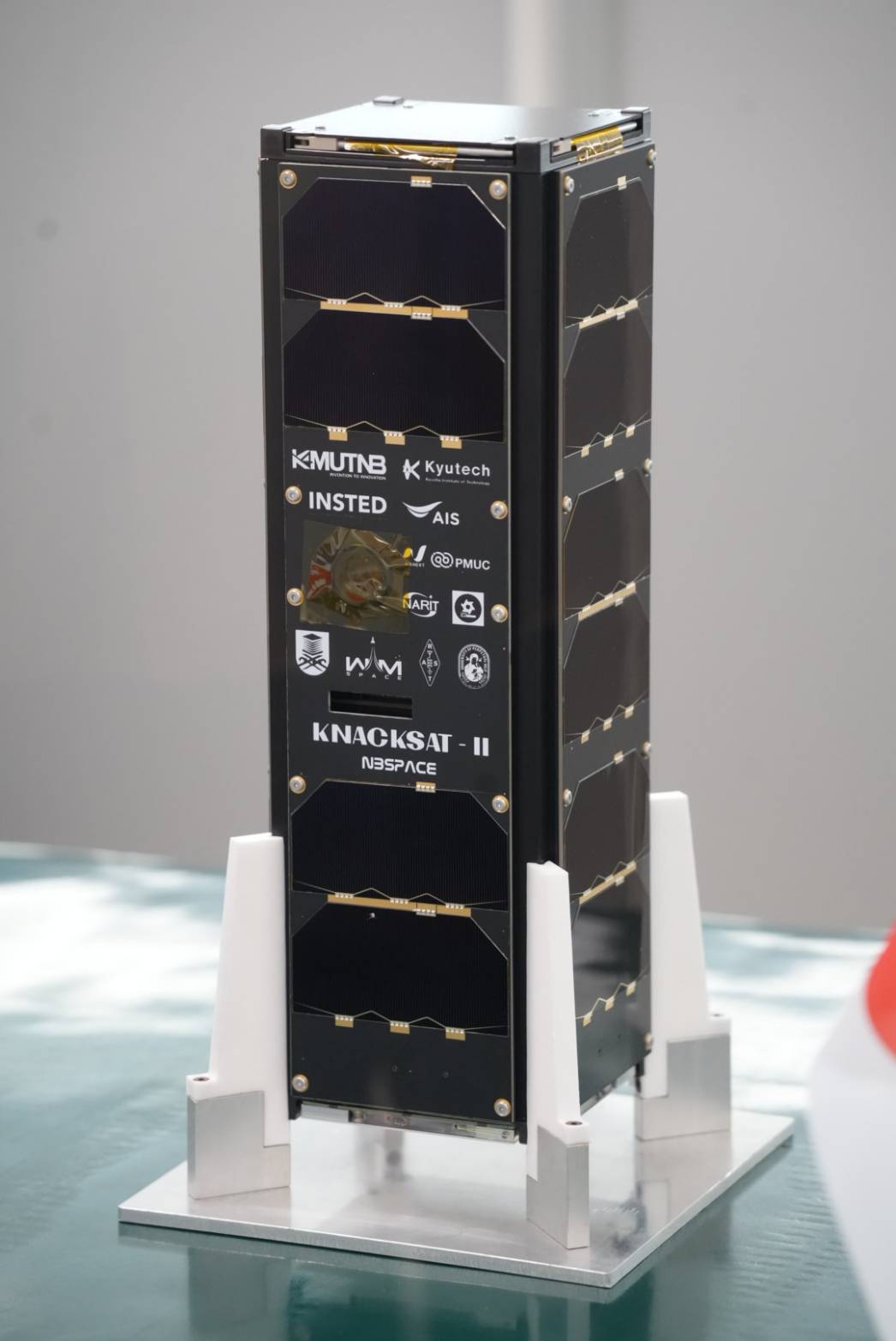 |
| Field | Previous | Suggested |
|---|---|---|
| Description | KNACKSAT-2 is a multi-payload 3U CubeSat developed by Thailand's King Mongkut's University of Technology North Bangkok (KMUTNB) in collaboration with several domestic and international partners. The satellite is designed to verify the functionality of up to 10 payloads for various organizations in a low-earth orbit. The mission aims to advance Thailand's space technology and provide more affordable access to space resources through a "ride-sharing" platform. | KNACKSAT-2 is a multi-payload 3U CubeSat developed by Thailand's King Mongkut's University of Technology North Bangkok (KMUTNB) in collaboration with several domestic and international partners. The satellite is designed to verify the functionality of up to 10 payloads for various organizations in a low-earth orbit. The mission aims to advance Thailand's space technology and provide more affordable access to space resources through a "ride-sharing" platform. VHF 1k2 Digipeater |
| Launch Date | Oct. 21, 2025, 12:01 a.m. | Oct. 26, 2025, midnight |
| Deploy Date | - | Feb. 3, 2026, midnight |