- Name
- BY70-4
- Alternate Names
- 8104, BY-04, 八一04星, 8104 Harbin MicroSat, 哈尔滨号
- Satellite ID
- EMBU-7314-7883-5821-1365
- Temporary NORAD ID
- 98247
- Followed NORAD ID
- None
- Country of Origin
-
China

Satellite is in orbit
Satellite is reported to be transmitting at an uncoordinated or denied frequency. Details
- Launch Date
- 2026-08-25T11:30:00+00:00
- Deploy Date
- 2026-08-25T11:35:00+00:00
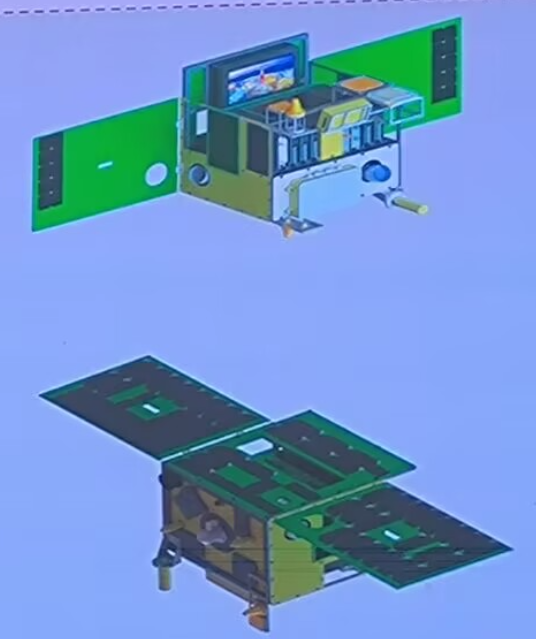
Harbin MicroSat (8104、BY-04、BY70-4、八一04星、8104 Harbin MicroSat、哈尔滨号) is a science education microsatellite developed by the LilacSat Team at Harbin Institute of Technology (HIT).
Drawing on its experience in the development of science education satellites and payloads, including the ASRTU Micro-Satellite, the LilacSat Team designed Harbin MicroSat as a next-generation platform for science education and student participation in space missions.
The satellite has a mass of approximately 18.7 kg and is designed to operate in a 500 ± 25 km Sun-synchronous orbit (SSO), with a planned on-orbit lifetime of one year. It is equipped with deorbit and autonomous collision-avoidance capabilities. Its attitude determination accuracy is ≤0.1° (3σ), pointing accuracy is ≤0.3° (3σ), and attitude stability is ≤0.05°/s (3σ).
The payloads include a high-definition camera, a science education display, a miniature camera, a polarization camera, and a short-message transponder. The high-definition camera provides at least 8 MP resolution and supports 4K video at 30 fps, while the 720p display can be remotely controlled from the ground to display educational content for space imaging activities.
The miniature camera has a 2592 × 1944 pixel sensor with a 90° field of view and supports 1920 × 1080 JPEG and SSDV imagery. SSDV images can be transmitted during ground-station passes with support for packet-loss retransmission.
The polarization camera has a resolution of 4112 × 3008 pixels, four polarization channels, and a spectral range of 400–760 nm. It is intended for polarization remote-sensing observations of the atmosphere and Earth's surface.
The spacecraft uses X-band and UHF/VHF communications. Its amateur-radio frequency coordination is inherited from the 8103 satellite. The UHF telemetry downlink operates on 437.443 MHz using 9600 bps BPSK and is compatible with the ASRTU telemetry format. The X-band communication system supports data rates of at least 1 Mbps.
Harbin MicroSat is scheduled for launch aboard a CZ-6C launch vehicle on August 25, 2026, at approximately 03:30 UTC (11:30 Beijing Time).
- Type
- Transmitter
- Downlink Mode
- BPSK
- Downlink Frequency
- 437443000.0
- Baud
- 9600
- IARU Coordination
- IARU Uncoordinated
| Observer | Latest Data |
|---|---|
| EU1XX-KO33ru | 2026-10-23 18:42:13 UTC |
| BG5JVM/BG5JSU/BH2VSQ-OL79wq | 2026-10-23 15:19:43 UTC |
- TLE Source
- Space-Track.org
- TLE Updated
- 2026-10-22 07:55:48 UTC
- TLE Set
-
1 98247U 26195E   26294.44585923  .00004362  00000-0  27141-3 0  9999
2 98247  97.5314   7.2824 0013750  78.6729 281.6044 15.10053689  8651